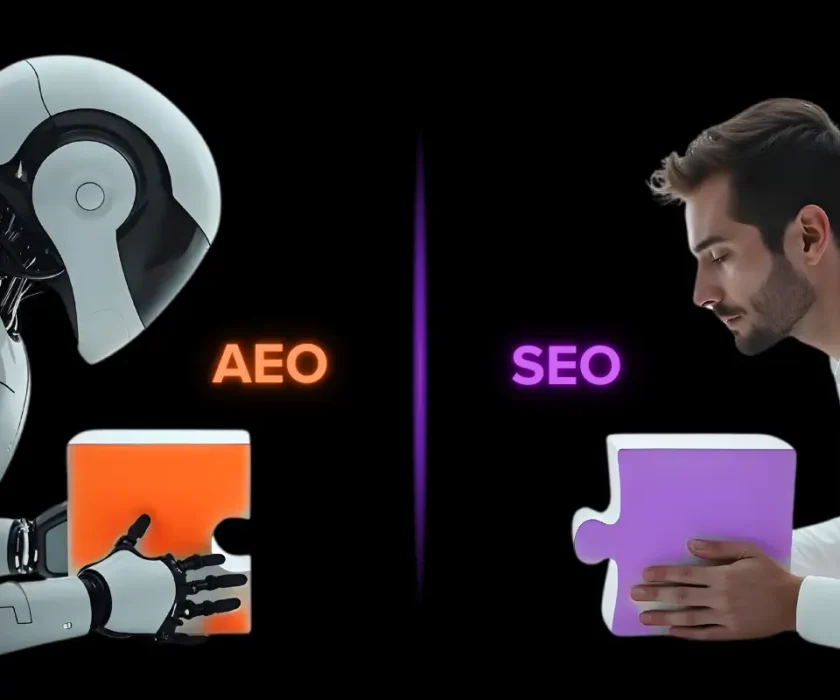

AEO (Answer Engine Optimization)
What happened in Search in 2016 wouldn’t happen in Search in 2026. Even in 2023, users were not asking questions from search engines by typing but by talking. Even now and in the past, search engines do not rank websites; instead, they provide direct answers.
In 2025 and 2026, AI-first searches scour the entire web, providing instant summaries. The old game of stuffing keywords and chasing backlinks no longer guarantees visibility.
This new landscape rewards brands that speak clearly, answer directly, and organize information with surgical precision. Traditional SEO isn’t dead but it’s no longer enough to stand alone.
Welcome to the era where visibility is earned through meaning, not metadata.
Familiarize Yourself with AI SEO
AI SEO is the process of optimizing the content for AI-driven systems, AI search engines, assistants, answer engines, and multimodal models that read like humans, not crawlers.
Instead of scanning for keywords, AI looks for the following:
- Intent
- Context
- Entities
- Clarity
It doesn’t just “index”; it interprets. It summarizes. It extracts meaning and evaluates whether your page is the safest, clearest, and most accurate source of information or not for the relevant question searched on the search engine.
Think of AI SEO as training your content to be the preferred explanation, the one an AI feels confident quoting.
Going Back to Traditional SEO?
The entire marketing industry has boomed and pitched the traditional SEO since forever, with its core elements based on keyword research, indexing, rankings, backlinks, metadata, and technical fixes.
Google’s crawlers read your pages, categorize them, and determine how well they match a specific query. Sites compete for content and rankings based on relevance, authority, speed, and structure.
Some of the old school ranking factors still in play are:
- Keywords: Think of keywords not as mere search terms, but as the precise questions your most valuable customers are asking in that very moment. This is what grabs the attention of your search engines first.
- Backlinks: A single, authoritative backlink is worth a thousand low-quality ones. It is an endorsement of the internet itself. It is what builds your authority in Google and other search engine results.
- Metadata: This is a 160-character summary or description of a page, which is your one-chance handshake with a searcher. Make it count. It should include the primary keyword.
- Technical Health: Before Google evaluates your content, it first analyzes your website. A slow, broken site is an unsigned contract. The first thing that we see and that matters in SEO is your technical performance of the website.
Are You Up for the AI SEO vs. Traditional SEO Game?
There is minimal discussion or comparison between AI SEO and traditional SEO. It’s a mere difference of only which and what exists. In traditional SEO, the search engine decides which pages to appear and in AI SEO, it decides what answer should be provided against the query or request of the user, hence summarized.
AI develops the understanding. A usual process in AI operation works like below:
- Concept Mapping
- Facts Extraction
- Validation of information
- Creating the right format of the answer (search, chatbots, voice tools or other multi-modal interfaces)
It’s all about the best explanation provided on any website and presenting it to the user.
However, when we talk about traditional SEO, the process varies slightly as it focuses more on the context and keyword alignment rather than forming precise information. It does not care much about clarity, digging deeper, understanding, and precision.
Some key differences between them are
- AI cares more about explanation, whereas traditional SEO cares about the ranking of the page
- AI helps in scanning the meaning of words, whereas traditional SEO scans for the keywords first
- AI cares more about authority signals, whereas traditional SEO checks for backlinks.
- AI looks more for clarity of the explanation, whereas traditional SEO favors coverage more.
Why Should We Still Care About Traditional SEO?
You can’t dominate AI results without a strong technical and structural foundation.
AI assistants still rely on indexed content. They still need clean site architecture. They still measure trust through the same signals Google has honed for years.
Traditional SEO provides the proof, the infrastructure, and the trustworthiness, and AI SEO amplifies it.
The fundamentals of traditional SEO include the following:
- E-E-A-T: Stop writing generic advice. Demonstrate your experience, prove your authority, and build trust with firsthand evidence, and let Google reward you for it.
- Link Structure: Don’t just scatter links. Build a logical pathway so readers—and search engines can easily discover your best content, turning casual visits into engaged sessions.
- Technical Clarity: If your reader needs a manual to understand your message, you’ve already lost. Simplify the complex, cut the jargon, and make every technical point effortlessly clear.
- Content Depth: Surface-level content attracts glances. Deep, comprehensive answers that anticipate every reader’s question are what capture loyalty—and top search rankings.
What will make you stay visible in 2026?
1. Be Crystal Clear In Answering the Questions
Write answers that directly address the specific questions users and AI systems ask. Eliminate unnecessary details.
2. Utilize Schema
The data feeds should be structured in a way that favors an AI context.
3. Make Entity Presence Stronger
There should be consistency when defining your brand, products, people, and locations across the web.
4. All the Website Pages Should Be Updated
Today, AI ranks what’s current, not what was beneficial in 2021, something that is already outdated.
5. Verified Experience Is What Will Help
Quotes, authors, credentials, and case studies add anything that signals “real people did this.” This is what makes it verified and authentic.
What AI SEO Techniques Outrank The Competitors?
One of the best ways is to optimize for extraction and summarization. Write your content as if it will be placed in an answer box, because that is likely to happen.
Use conversational queries, map context, incorporate multiple content formats, and build pages that AI can quote without hesitation.
Here are some pro-tips that will help you win against your competitors
- Clear headings
- Short, direct answers
- Defined entities
- Clean internal links
3 Things That Brands Need to Stop Doing?
- Stuffing, stuffing & stuffing! Stop keyword stuffing; this is one of the major things that confuses modern AI more than it convinces it.
- Furthermore, stop writing long introductions; nobody has time, especially an AI.
- Moreover, stop publishing vague content with no author identity; trust is the new currency.
FAQs
Does AI replace traditional SEO?
No, AI SEO expands it. You need both for visibility in 2026.
How does AI decide what to quote?
It pulls from clear, structured, authoritative content with verified entities.
Is keyword research still relevant?
Yes, but more for understanding intent than forcing phrases.
Do I need a schema for AI SEO?
It’s not optional anymore schema is context fuel.
What boosts authority for AI models?
Experience, accuracy, citations, and consistent entity signals are the factors that enhance the authority of AI models
AI SEO, Traditional SEO, and Entity SEO now operate as one ecosystem.
Visibility goes to brands that communicate clearly, organize their knowledge, and prove they’re credible.
In 2026, search belongs to the brands that embrace clarity, accuracy, and trust—and teach AI how to recognize them.